Cannabis Bluttest 2026: What the Blood Test Means in Germany, Canada, and the US
If your search term is "cannabis bluttest," you probably want one clear answer: does this result mean I am intoxicated now, or just that THC was used earlier?
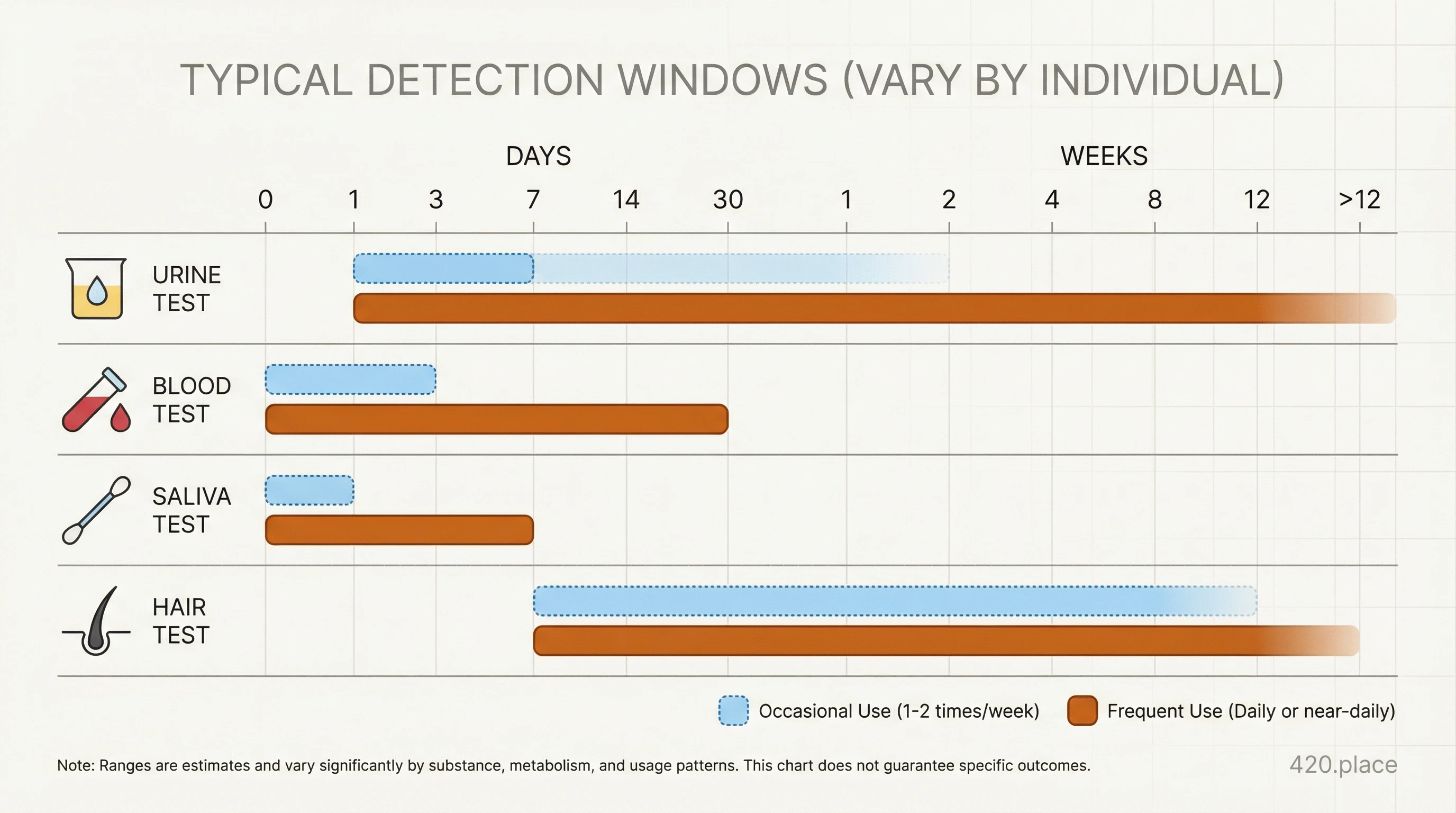
The answer is usually: a blood test is not a universal impairment meter.
The key distinction: sample type changes interpretation
A practical framework:
- Blood (serum) is best for recent-time interpretation and is often used when a timeline is legally relevant.
- Oral fluid / saliva is a screening matrix used for quick roadside checks.
- Urine is metabolite based and can stay positive longer than blood after effects fade.
This is consistent with toxicology work: cutoff and sample matrix choices can shift detection timing by days, especially for frequent users.
What current science shows about detection windows
In clinical toxicology literature, THC concentration is highly time-dependent:
- One-time use generally shortens blood detectability much earlier than urine metabolite detectability.
- Frequent use can create longer and noisier detection tails, especially in blood and oral fluid.
- Lab cutoff choice strongly affects results, so the same person can test differently under different protocols.
Because of that, the safest interpretation is:
- Keep method context with every result. 2. Do not treat one positive as a direct behavior score. 3. If safety-sensitive decisions are involved, use a conservative return-to-task check.
Germany: why legal interpretation looks different there
Germany's road-safety system has a federal framework under the Road Traffic Act with specific rules in §§24a and 24c, and ongoing federal discussions around THC limits and enforcement practice.
The federal transport ministry also published expert recommendations for a THC blood-serum operational threshold in the context of road safety.
For non-safety decisions (for example, insurance or non-traffic administration), result interpretation still depends on test purpose and local procedure. Practical implication:
- A positive sample in itself rarely defines the whole legal story.
- Method, threshold, and context (time since use, signs, route) remain central.
- Newer discussion in Germany increasingly separates old and new threshold logic in public commentary.
When in doubt, document:
- last use time,
- route of use,
- timing of sample,
- symptoms and performance effects,
- and whether oral fluid vs blood was used.
Canada & US comparison: same molecule, different thresholds
In Canada, provinces and courts also combine biological thresholds with impairment evaluation and roadside/confirmatory testing structure. In the US, state systems vary more and often combine federal guidance, employer policy, and state testing standards.
Across both systems, what repeatedly matters:
- Context matters more than one standalone number.
- Confirmatory testing is usually required after a screening signal.
- Method choice (screening vs confirmatory matrix) can fully change what result is reported.
For users, this means practical caution should be identical:
- never assume a negative oral fluid means no risk in the next hours,
- never assume a positive screening means automatic severe impairment,
- never self-adjust medication or dosing based on one lab output.
Practical action plan after an unexpected blood result
Use this sequence once you have a result:
- Note the exact sample source (blood, saliva, urine) and the cutoff used. 2. Keep a strict timing log for last use and sleep, food, and co-substances. 3. If your result affects driving, work, or school outcomes, avoid high-risk tasks until professional review is complete. 4. Ask for chain-of-custody and confirmation steps if it is an official roadside/laboratory workflow. 5. If you are in treatment or on medications, loop in a licensed clinician before changing use behavior.
This is especially important for chronic users, where residual THC in blood can appear out of sync with current function.
What this article does not replace
This page is educational. It is not legal or medical advice and does not replace:
- clinician guidance,
- legal counsel for case-specific defense,
- workplace policy for HR disputes,
- or emergency care in severe symptoms.
Related Resources
- Germany legal framework: /article/laws-germany
- US legal snapshot: /article/laws-united-states
- Canada legal snapshot: /article/laws-canada
- Testing methodology basics: /article/cannabis-testing-science-2026
- Time-frame matrix: /article/cannabis-blood-test-time-frame-2026
- Police and rights: /article/cannabis-blood-test-police-and-rights-2026
- Workplace context: /article/cannabis-blood-test-and-workplace-testing-guide-2026
- General safe use context: /article/general-cannabis-2026
Related reading
Operator review checklist
For "Cannabis Bluttest 2026: What the Blood Test Means in Germany, Canada, and the US", reconcile each material claim with the page's existing source record:
- confirm the jurisdiction or studied population, effective date, and applicability;
- distinguish direct support from inference or unresolved evidence;
- route legal, medical, medication, impairment, or dosing questions to a qualified reviewer.