Cannabis Blood Test Time Frame 2026: What It Usually Means
If your search is "cannabis blood test how long", the first helpful answer is: there is no single global number. Time frames are always conditional on test matrix, cutoff level, and use pattern. The practical question is not only whether a test is positive--it is what result type you got and what decision should follow.
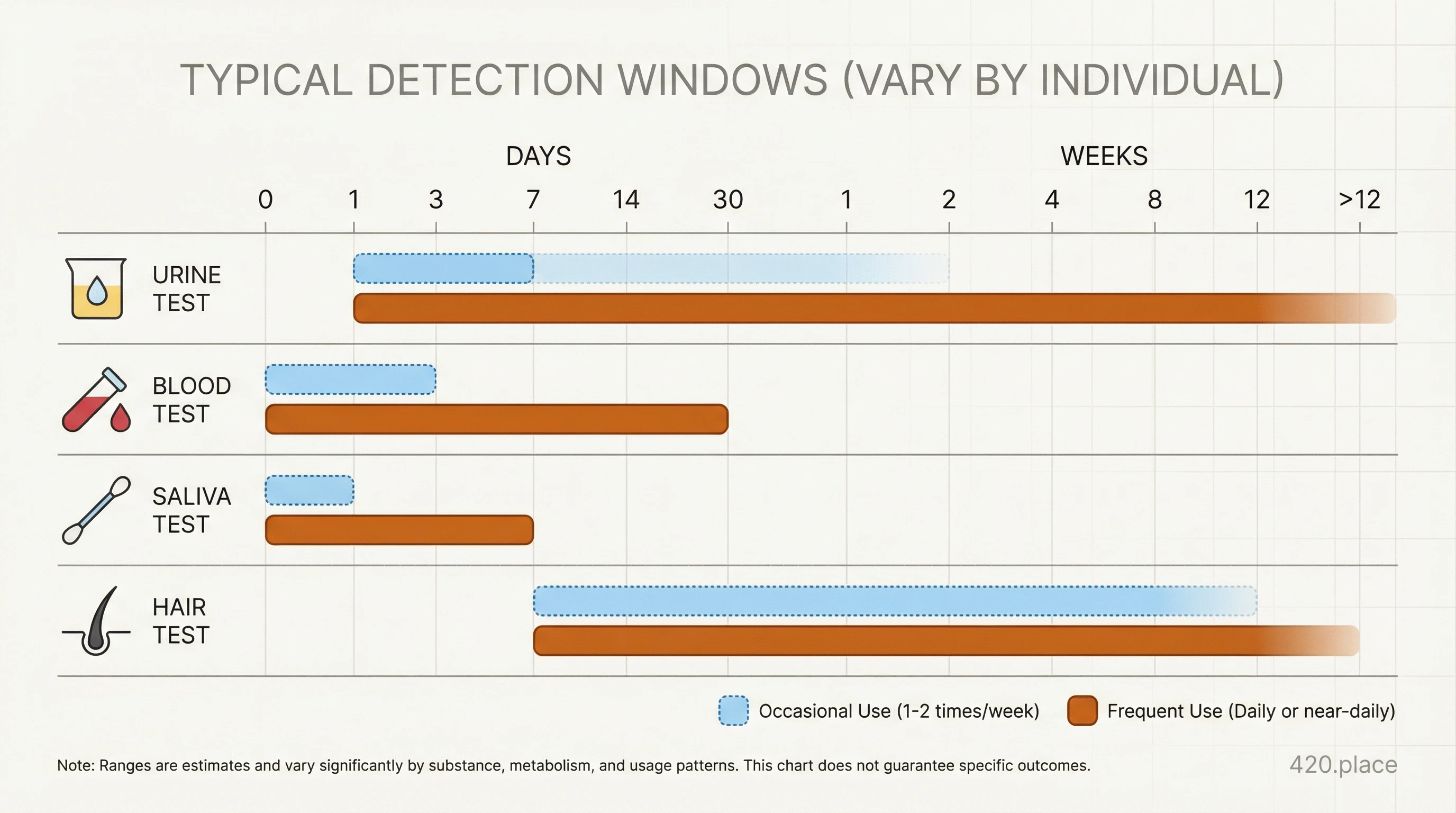
The common mistake
People often treat all positives as either "proof" or "nothing happened". Both extremes are wrong.
- A positive blood THC sample is usually tied to recent exposure windows and specific lab methods, not a universal impairment scale.
- A positive urine sample is often a metabolite finding that can remain long after effects fade.
- A negative blood result does not automatically mean there is no safety risk if timing, fatigue, or co-use still matter.
Typical timeline framework
Use this practical frame for reader communication and planning:
- Blood sample: generally shorter windows than urine, but still variable by frequency, dose, metabolism, and assay design. 2. Oral fluid (saliva): often used for roadside and rapid screening because it reflects very recent exposure in many workflows. 3. Urine: often detects THC metabolites longer and is therefore often used for historical confirmation and workplace policies. 4. Hair: can indicate weeks to months of exposure context, but is less common for immediate safety decisions.
From the toxicology literature, one robust point is consistent: assay cutoffs and interpretation frameworks alter window estimates as much as biology in some scenarios. That means the same person can be classified differently across programs if methods differ.
What most users should do with timing results
If positive
- Record exact last-use time, route, and dose.
- Ask for sample type and cutoff value used.
- Track objective symptoms rather than using one result as a final safety verdict.
- In safety-critical jobs or before driving, use a conservative return-to-duty plan until clinician or occupational review is complete.
If negative
- Confirm if the assay can miss very recent use windows depending on timing.
- Re-test only under official procedure if the consequence is high-risk.
- Do not self-clear based on one negative if you still feel impaired.
Regional context
United States
Drug-testing workflows in the US remain state- and program-specific. For practical value, prioritize method context (sample type and policy), not just the number on a report.
Canada
Canada's regional enforcement environment includes roadside and follow-up testing pathways for impairment cases and workplace programs. Provincial resources generally emphasize policy-driven interpretation and public safety decisions, not a single fixed sobriety timer.
Germany
Germany's statutory framework uses specific legal text and threshold-based enforcement patterns for cannabis in transport contexts. As in North America, legal consequence depends on context and process, not one broad timing myth.
FAQ
What is a realistic rule for planning after a cannabis blood test?
Use a conservative safety rule: assume decision-making needs matrix context, method details, and recovery observation--not one timing value.
Can a single positive blood test mean I was impaired for all that window?
No. Blood tests indicate exposure context. Impairment is influenced by dose, route, and behavior over time, and should not be inferred as a direct one-to-one certainty.
Why can two people with similar use have different windows?
Body composition, use frequency, hydration, route, and assay design all alter detection behavior.
Does urine positivity mean I am currently impaired?
Usually not by itself. Urine is often metabolite-focused and can stay positive after acute effects diminish.
How should I compare US, Canada, Germany results?
Use country and process context first: legal consequences and follow-up procedures differ even if lab findings look similar.
Related reading
- Cannabis blood test duration guide
- Cannabis blood test and workplace guide
- Cannabis blood test rights and police workflow
Operator review checklist
For "Cannabis Blood Test Time Frame 2026: What It Usually Means", reconcile each material claim with the page's existing source record:
- confirm the jurisdiction or studied population, effective date, and applicability;
- distinguish direct support from inference or unresolved evidence;
- route legal, medical, medication, impairment, or dosing questions to a qualified reviewer.