General Cannabis at Work 2026: Policy, Testing, and Safety Decisions
If your question is "cannabis at work", you are usually comparing three things at once:
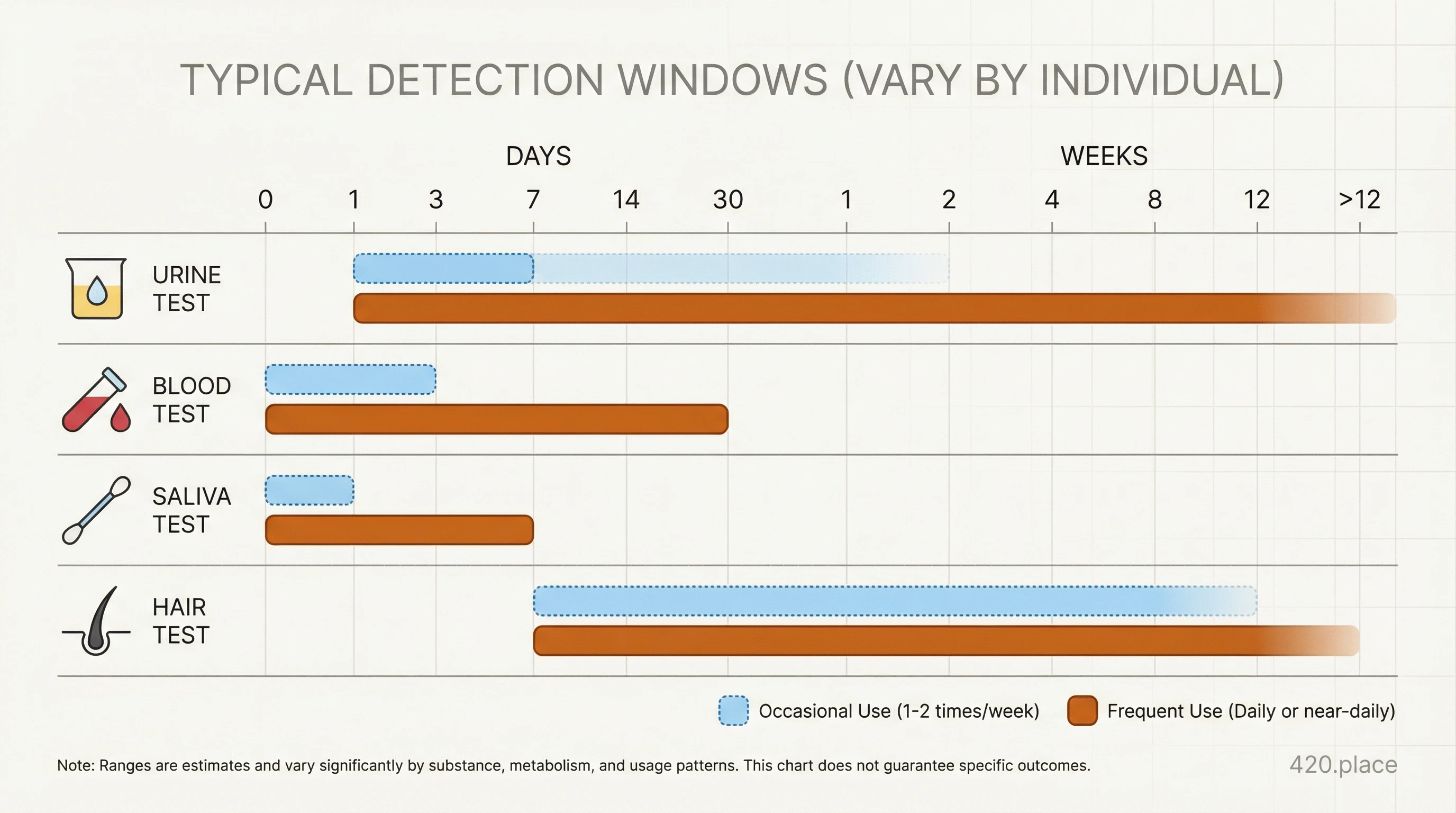
- Whether a test result applies to your specific job, not your whole life
- Whether you are actually impaired, or only testing positive
- How to stay compliant in a system that changes by country and role
The useful correction is simple: workplace cannabis risk is role-based. Safety exposure depends on your task and the legal setting, not one universal rule.
Why results feel confusing
People treat one result as one decision. But workplace context is made from layers:
- policy layer: what your employer requires for your role,
- method layer: urine, saliva, or blood matrix and cutoff details,
- functional layer: task risk, fatigue, and impairment signs,
- region layer: legal framework for your country.
Without this stack, the same result can lead to opposite conclusions in two companies.
Core rule for all regions
A positive test alone is not the full answer.
- A workplace test result can indicate exposure.
- It does not automatically quantify real-time performance.
- A negative result does not remove all safety risk.
For safety-sensitive roles, this means the practical standard is conservative: treat method details as a trigger for action, then apply role-based review.
US context: policy-first interpretation
In the US, workplace drug guidance remains policy-heavy and role-specific. The practical pattern that appears repeatedly is:
- clarify the job risk class before deciding consequences,
- confirm what sample matrix was used,
- request confirmation and cutoff details before formal disciplinary conclusions,
- preserve chain-of-custody and method documentation.
If your role involves vehicles, machinery, or public safety, follow a stricter return-to-duty protocol than an office role.
Canada context: provincial and operational variation
Canada users face additional variation between provinces and employers. Public-health framing and workplace safety guidance tend to emphasize documented process and risk management.
For this reason, ask for:
- policy document sections on medical-use and probation/review procedures,
- test type and confirmation method,
- role-specific restrictions after a positive signal.
Germany context: legal structure and documentation discipline
Germany adds a stronger documentation expectation around medical use. Even when medical justification is available, workplace application still depends on job safety, workplace compliance, and legal process details.
Two practical standards repeat:
- match local legal process to job function,
- use written timing and disclosure records if your use pattern is being evaluated.
72-hour workplace decision matrix
Use this before high-risk duty:
- 0-24 hours: avoid operating safety-sensitive functions and driving. 2. 24-48 hours: re-check symptoms, sleep quality, and any co-use. 3. After documentation: return only with supervisor/medical confirmation for roles with public risk.
What to do when a test result arrives
- Ask for test source, matrix, and threshold. 2. Ask for whether confirmatory testing was used. 3. Write a timing and route log (last use, dose, route, sleep). 4. Escalate into HR/safety channels if your role is high-risk. 5. Do not alter medication use without licensed clinical guidance.
Related reading in this site
- /article/cannabis-at-work-guide-2026 for a direct workplace test walkthrough.
- /article/cannabis-blood-test-and-workplace-testing-guide-2026 for sample-specific interpretation.
- /article/cannabis-blood-test-time-frame-2026 for result timing context.
- /article/laws-united-states, /article/laws-canada, and /article/laws-germany for legal baseline.