Cannabis Blood Test How Long: What Timing Really Means
If your search is "cannabis blood test how long", you likely need a decision quickly, not a chemistry lecture.
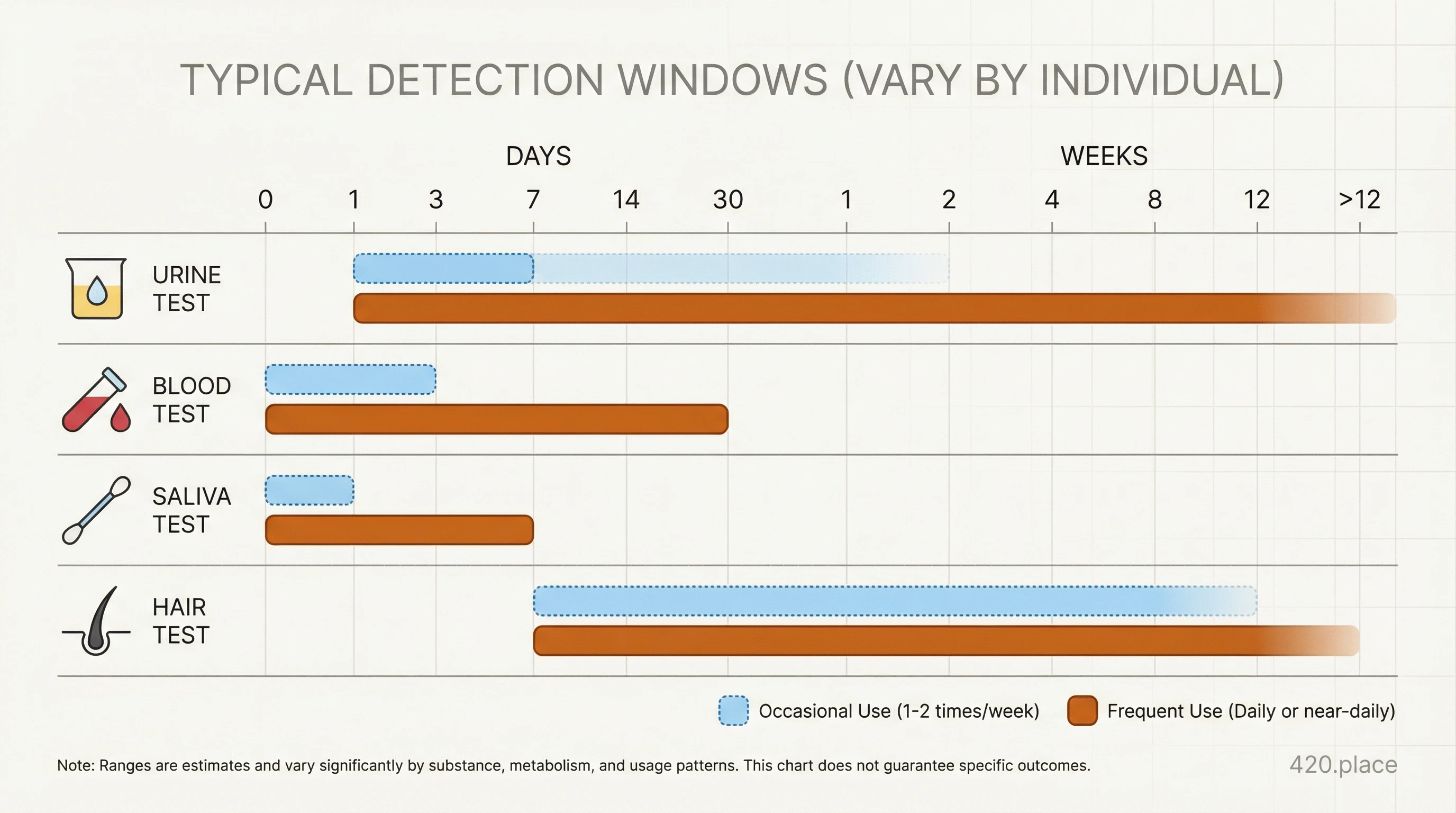
The practical rule is this: there is no universal single number. Timing depends on method, cutoff, use pattern, and legal or workplace context.
Why timing can mislead
Two people can get different windows from the same use pattern because:
- test matrix (blood, urine, saliva),
- assay thresholds,
- frequency and route,
- body factors and hydration,
- and the policy purpose of the test.
When timing language ignores these, people overreact or under-react.
What test type usually means
| Test type | What it usually measures | Practical timing takeaway |
|---|---|---|
| Blood | parent THC and closely related compounds | Usually useful for short-window decisions, but still affected by use pattern and cutoffs |
| Urine | THC metabolites (especially THCCOOH) | Can remain positive after effects fade; often used in policy-driven workflows |
| Saliva | recent exposure markers | Often used in roadside or short-window screening |
| Hair | longer exposure history | Useful for chronic pattern context, less useful for immediate safety decisions |
Common window logic (practical, not absolute)
- For occasional use, urine windows often close sooner than for frequent use.
- In frequent use, residual signals can persist longer.
- Lower assay cutoffs usually extend detection length.
- A more recent sample does not automatically mean higher impairment than an older sample; it means the method and cutoff matched the workflow.
Use this framework in your own planning: window + context + purpose.
High-confidence decision sequence
Step 1: Identify the test and cutoff
Ask for:
- sample type,
- assay threshold,
- whether result is screening or confirmatory,
- collection timing vs last use time.
Step 2: Separate legal/workplace intent from health tracking
For legal or safety-critical outcomes, method interpretation plus role risk matters more than one window estimate.
For personal health tracking, do not treat the first result as the final score. Keep a 24 to 48 hour function log before changing routine.
Step 3: Match action to consequence level
- If workplace safety is involved, follow return-to-task guidance.
- If legal consequences are in play, consult counsel before assumptions.
- If health is affected, involve a clinician before dose adjustments.
US, Canada, and Germany timing context
United States
US testing systems are program-specific. Workplace, law enforcement, and administrative processes can produce different timing interpretations for the same substance profile.
Canada
Canada combines public-health messaging and enforcement channels where context drives interpretation. Regional practices can vary in roadside follow-up, workplace handling, and safety response design.
Germany
German legal frameworks emphasize statutory process and documented procedure. Interpretation depends on how the result fits the legal pathway and sampling method, not on one timing phrase alone.
What to do with a new result
- record method, collection time, and last use,
- verify if result is screening-only or confirmatory,
- avoid major legal or clinical changes from one isolated sample,
- keep a practical symptom and task-risk log for the next 48 hours.
This keeps your next move stable and evidence-based.
FAQ
Is blood always the fastest test to clear?
Not always. Blood reflects different compounds and may still vary by timing and assay details.
Can urine testing stay positive after effects fade?
Yes. Urine can remain positive beyond short-term effect windows.
Do frequent users always have longer windows?
Often, though cutoff and test design influence this as much as biology.
Why do results differ across countries?
Different systems use different workflow standards, and one legal question is not always answered by the same matrix threshold.
What if I only need this for planning?
Use method context, low-risk task reduction first, and documented logs before changing larger behavior patterns.