Cannabis Testing 2026: Blood, Urine, and Saliva, Explained
If your search is "cannabis testing," you are often asking one practical question: how do I use test results without overreacting to one headline number?
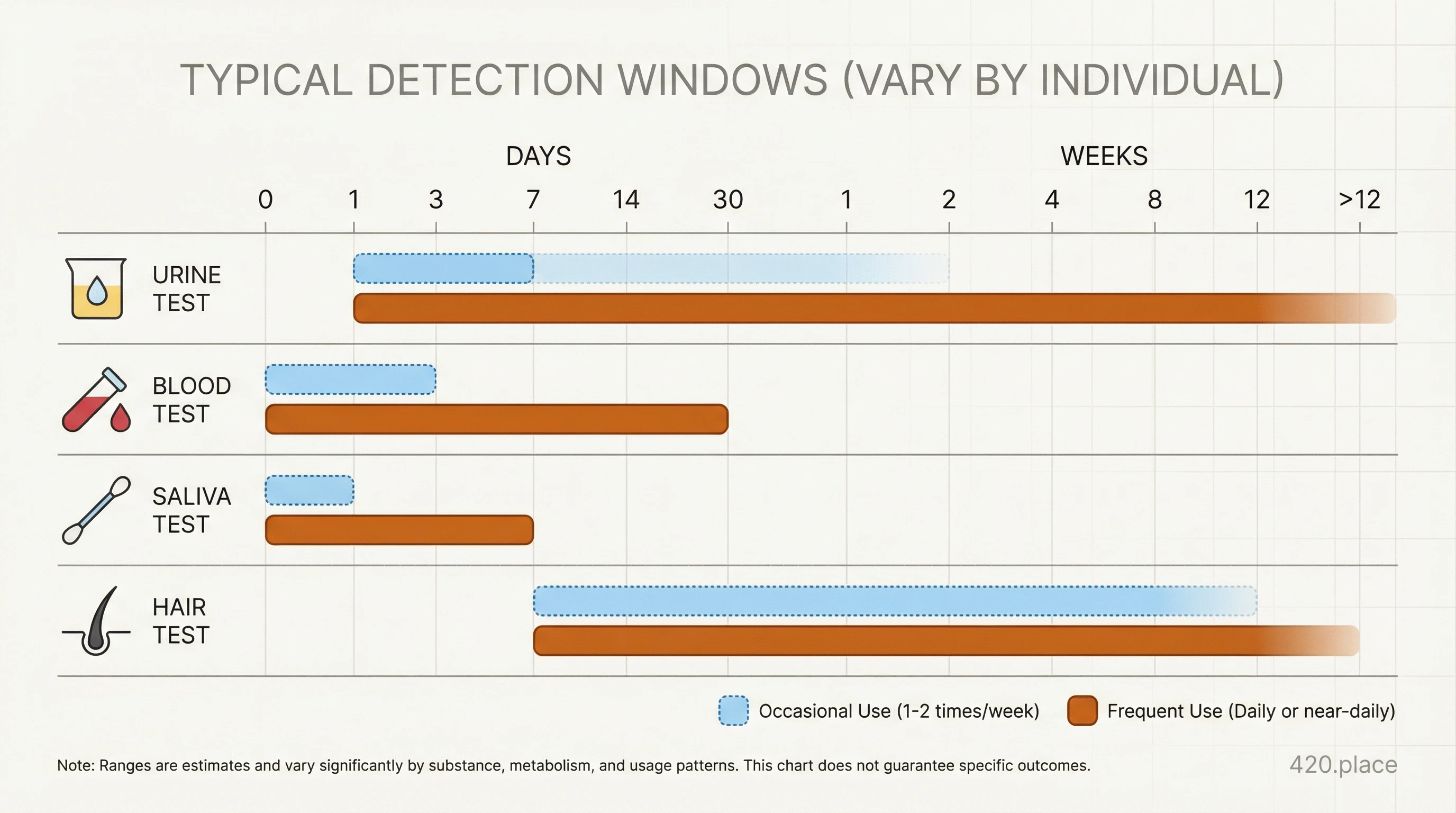
This is the main rule: a cannabis result is not one universal outcome. Different test methods answer different questions, and each country or program uses those answers differently.
Why one result can confuse everyone
Even with the same person and similar use pattern, two reports can diverge. This happens when workflows change across:
- sample type (blood, urine, saliva, or hair),
- assay cutoff values,
- timing of collection,
- and legal or workplace purpose.
Without method context, results become easy to misread.
Test matrix and what each method can usually tell you
| Test type | What it usually detects | Typical use | Main limitation |
|---|---|---|---|
| Blood | recent THC or parent compounds | rapid risk and safety decisions | short window, but timing still varies by person and lab method |
| Urine | THC metabolites | workplace or compliance workflows | does not prove immediate current impairment |
| Saliva | recent exposure markers | roadside or short-window screening | false positives and short windows depend on protocol |
| Hair | longer exposure history | historical intake patterns | low role for immediate safety decisions |
A method-first interpretation
Step 1: Ask what decision the test supports
You first need to know the question:
- Is this for immediate safety or law enforcement context?
- Is this for workplace compliance?
- Is this for historical exposure documentation?
When you identify this first, the right method usually becomes clearer.
Step 2: Check method details before conclusion
- sample matrix,
- test purpose,
- cutoff levels,
- confirmatory vs screening status.
A screening line can start an investigation. A confirmed finding changes risk weight and next action.
Step 3: Pair with behavior, task risk, and timing
A result alone should not replace observation. For safety-critical tasks, recovery and function checks still matter as soon as possible after testing.
Practical route for common intents
If the question is workplace screening
Use the workplace policy details first, then request chain-of-custody and test methodology details. If workplace safety is involved, return-to-duty decisions should be conservative until method and role fit are clear.
If the question is legal defense or road-safety context
Treat jurisdiction context as part of the test. Collection method, timing, and enforcement framework are usually decisive, especially in contested cases.
If the question is health tracking
If this is personal tracking, use a simple timeline log with dose, route, and sleep context. Compare this with any lab result before changing dose or behavior patterns.
US, Canada, and Germany context in one view
United States
Cannabis testing logic is program-specific. Workplace screening, roadside workflows, and prosecutorial pathways can differ by state, court route, or employer policy.
Canada
Canadian frameworks combine public-health messaging and enforcement pathways where context matters. Provincial practices may vary by region, especially for road safety and medical use settings.
Germany
Germany uses a strong legal-process model with formal statutory anchors in traffic and administration. Interpretation tends to be tied to method and legal purpose, not a single universal threshold.
What to do if you get a result today
- Record the exact method and timing details.
- Keep a practical symptom and safety log for the next 24 to 48 hours.
- Do not make legal or high-risk decisions from a single result line.
- Ask an attorney for legal steps, and ask a clinician for health or medication adjustments.
Related reading
- Cannabis blood test time frame guide
- Cannabis blood test duration guide
- Cannabis blood test interpretation guide
- Cannabis testing science page
- How long does weed stay in your system?
FAQ
Can one cannabis test prove legal guilt?
No single test is usually enough by itself. It is usually a piece of a larger legal or workplace chain that includes timing, method, and context.
Why are blood and urine results different?
They measure related but not identical signals, with different windows and interpretation goals.
Can I use a saliva result instead of blood?
They are useful for different questions. Saliva can support short-window screening, while blood is often used differently depending on the workflow.
Does this mean every positive is bad?
Not necessarily. A positive result shows exposure for that method and threshold. You still need context for action.
How should I compare results across countries?
Do not compare raw numbers alone. Compare method, threshold, and local legal process first.