Cannabis Testing Time 2026: Which Clock Is Running?
If your search is "cannabis blood test time", you are usually asking one simple question:
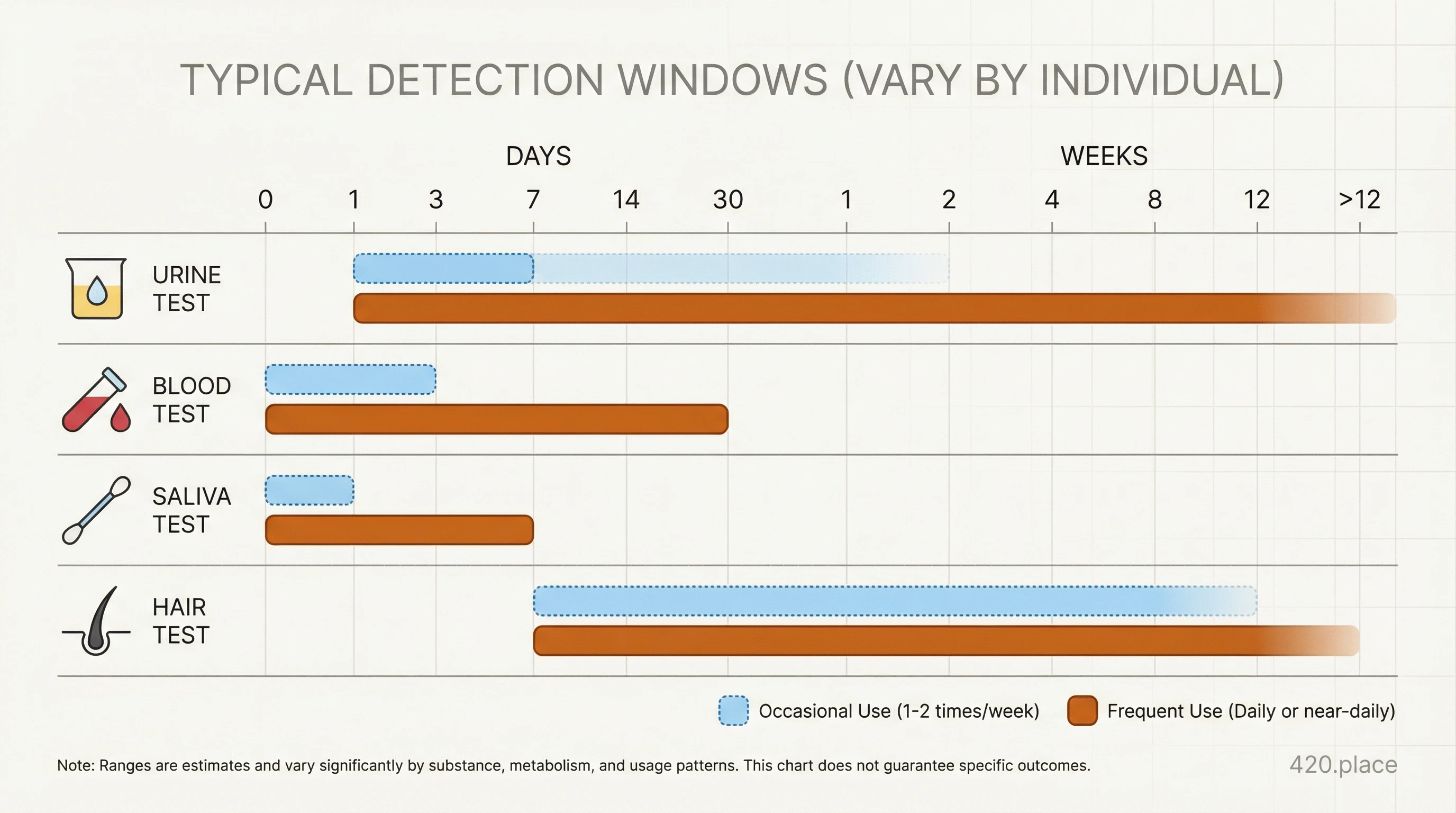
Which time frame should I use right now?
The reliable answer starts with a hard separation:
- Biological window clock: how long markers from a cannabis sample can remain detectable,
- Processing clock: how quickly a sample is screened, confirmed, and reported,
- Policy clock: how legal, workplace, or safety timelines are calculated.
Those three clocks are not interchangeable.
The most common timing mistake
People usually mix them up when they treat a single timing line as a final answer.
Example:
- a fast on-site screen does not always resolve legal consequences,
- a later positive urine/metabolite result does not automatically mean immediate impairment,
- a delayed lab window does not always mean higher personal risk.
The corrective method is not more complexity. It is a cleaner sequence.
Which clock is relevant to your question?
Use this quick classification before acting:
| Question | Clock | What this does NOT answer |
|---|---|---|
| "How long can it stay positive?" | Biological window | Immediate safety level |
| "When will I get results?" | Processing clock | Whether the result is final |
| "How long before legal action starts?" | Policy clock | How your body metabolizes THC |
In practice, each answer has its own action set.
Practical meaning of biological windows
Across blood, urine, saliva, and hair methods, no single window fits every person. Key practical limits:
- use pattern (occasional vs frequent) changes output timing,
- route and dose pattern changes peak and return,
- testing matrix changes what marker is detected,
- cutoff thresholds can make timing claims appear shorter or longer than expected.
This is why two people with similar use can get different windows under similar language.
Processing clock: what to expect after sample collection
Processing is where urgency often starts.
Screening stage
Screening is usually designed for rapid direction, not final legal certainty.
Confirmation stage
Confirmatory pathways usually require dedicated confirmation and method documentation before stronger action.
Post-confirmation administrative stage
Depending on role, there may be another delay before action windows update or appeal steps begin.
If this is a safety-critical situation, use conservative behavior during the gap:
- avoid high-risk tasks,
- do not make irreversible personal changes based on one signal,
- keep a method/time log with method, cutoff, and collection timing.
Policy clock by country context
United States
US timelines remain fragmented by program and use case. Workplace policy, roadside procedures, and legal context can all run on different decision calendars.
Canada
Canadian workflows vary by province and pathway. Public-health and enforcement routes can differ in how quickly action windows change.
Germany
German enforcement and legal frameworks are strongly procedural. Method documentation and evidence context are central, so timeline interpretation depends on pathway clarity.
When timing is clear enough to act
Use this decision rule:
- Identify the active clock (detection vs processing vs policy),
- Collect proof fields (sample, timestamp, requested method, cutoff),
- Match action severity to the active pathway.
If health is already concerning, involve a clinician quickly. If legal consequences are active, involve legal counsel quickly.
FAQ
Is test speed the same as test reliability?
No. Speed can improve responsiveness, but reliability still depends on method stage and confirmation context.
Can I compare blood and urine windows directly?
No. They answer different marker questions, so comparison without context can mislead.
Does a negative roadside screen end the issue?
Not always. A negative screen can reduce immediate concern, but policy timelines can still apply if context changes.
Can I retest right away if I get an unclear result?
Usually not. Immediate retests can add confusion unless protocol and timing are already standardized.
If I feel impaired and wait for results, what is the immediate step?
The immediate step is safety: avoid risky behavior, stay put on a safe routine, and seek urgent care if severe symptoms appear.